Microsoft Fabric it has become one of the main protagonists of the data ecosystem in 2026. What began as a natural evolution of Power BI has transformed into a comprehensive platform that is redefining how companies manage, analyse and activate their data in the era of artificial intelligence.
The figures, recent announcements and market interest point to one clear conclusion: Fabric is not just a trend; it is a consolidated strategic commitment in the business world.
📊 Record growth: adoption in full acceleration
In less than three years since its launch, Microsoft Fabric has reached figures that explain its impact:
- More from 31,000 active customers globally
- Presence in up to the 80% of the Fortune 500 companies
- More from 15,000 companies identified as users market analysis
This growth makes it the fastest-growing data platform in Microsoft's history
Furthermore, its adoption is not limited to large corporations:
- 40% for use in medium-sized businesses
- 36% in large companies
- 23% in small organisations
👉 In other words, Fabric is penetrating the entire business fabric, not just in large accounts.
🚀 Why is it growing so much?
1. Unified platform (the end of the “data Frankenstein”)
The main differential factor is its proposition: all-in-one.
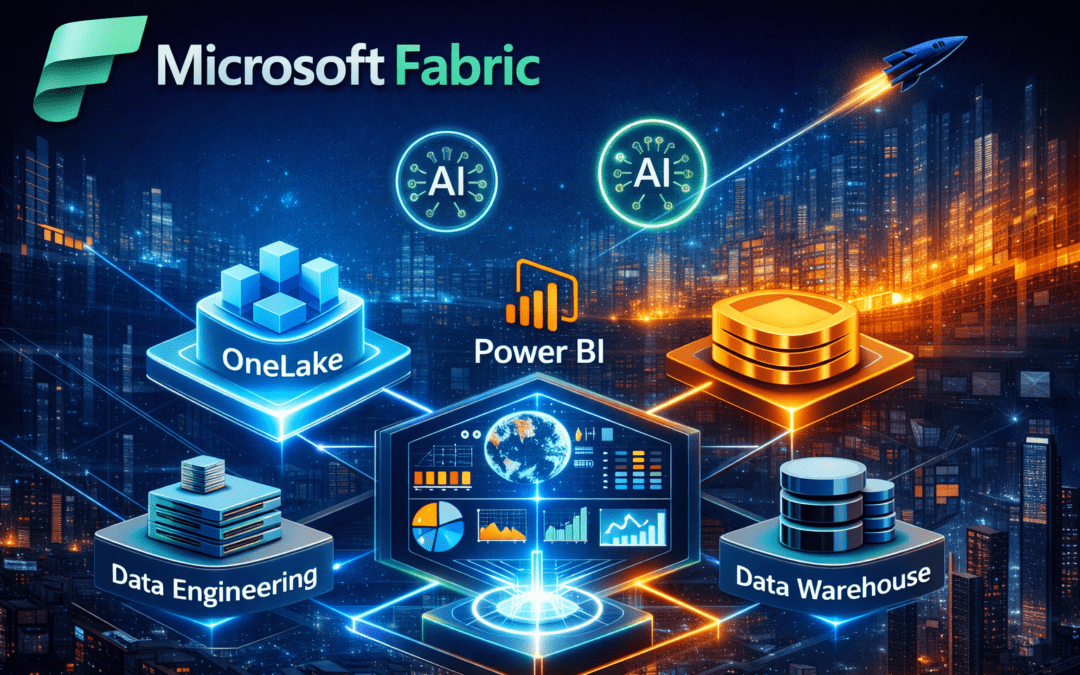
Fabric integrates:
- Data Engineering
- Data Factory
- Data Science
- Data Warehouse
- Power BI
- Real-time analytics
Everything on a single layer: OneLake.
This enables companies to break down silos and reduce complexity, one of the biggest long-standing problems with data.
2. Native AI integration
Fabric It’s not just a data platform; it’s a “AI-ready” data platform”.
The latest updates reinforce this view:
- Integration with Fabric IQ (semantic layer for AI)
- Data engineering automation with agents
- Consumption-ready models by Copilot
This addresses a key need:
👉 without well-structured data, AI doesn't work.
3. Proven ROI and efficiency
Economic data are also driving adoption:
- ROI of 379% over 3 years according to Forrester studies
- +20% productivity among analysts
- +25% productivity among data engineers
- Significant reduction in legacy infrastructure
In other words:
Fabric not only modernises, it also saves money.
4. The knock-on effect of Power BI
Fabric's growth is closely linked to Power BI:
- Power BI grew a year-on-year 40% in 2025
- Fabric acts as its natural evolution, integrating the entire backend
👉 Many companies don't “adopt Fabric from scratch”, but rather they evolve from Power BI.
🧠 Latest news: towards autonomous data
Recent announcements at events like FabCon 2026 show where the platform is heading:
🔹 OneLake as an open standard
- Integration with SAP, Snowflake or Databricks
- Zero-copy / zero-ETL architecture“
🔹 Database Hub
- Unified database governance
- Centralised observability
🔹 AI applied to the entire data lifecycle
- AI-assisted engineering
- Pipeline automation
- Preparation for autonomous agents
👉 The aim is clear: moving from data platforms to intelligent data systems“.
🏢 Sectors and use cases
Fabric it is already being used in key sectors:
- Professional services and consultancy
- Industry and manufacturing
- Finance and banking
- Retail and logistics
Companies like Coca-Cola are using it to build unified data platforms on a global scale
🔎 Conclusion: Microsoft Fabric: from trend to strategic pillar in the era of data and AI
Microsoft Fabric In a very short space of time, it has gone from being a novelty to establishing itself as one of the most relevant data platforms on the market, driving mass adoption across companies of all sizes. Its unified proposition—which integrates engineering, analytics, data science, and visualisation under OneLake—is making it possible to eliminate silos and simplify complex architectures, while its native integration with artificial intelligence accelerates the activation of data within organisations.
👉 Today, Fabric it is already the foundation upon which many companies are building their data and AI strategy.
Their success is down to three key factors:
- Technological simplification
- AI integration
- Direct business impact
The results speak for themselves: high growth, significant ROI and productivity improvements.
In a context where data is the new oil and AI the engine, Fabric aims to become more than just a tool:
👉 the enterprise operating system for data intelligence.
🚀 Next Step we help you to successfully adopt Fabric
Next Step we help businesses to adopt Microsoft Fabric with a practical and business-oriented focus. We have active clients and success stories where we are already implementing real solutions based on this technology. Let us accompany you!Take the next step with us!
Contact | Next Step Consultants