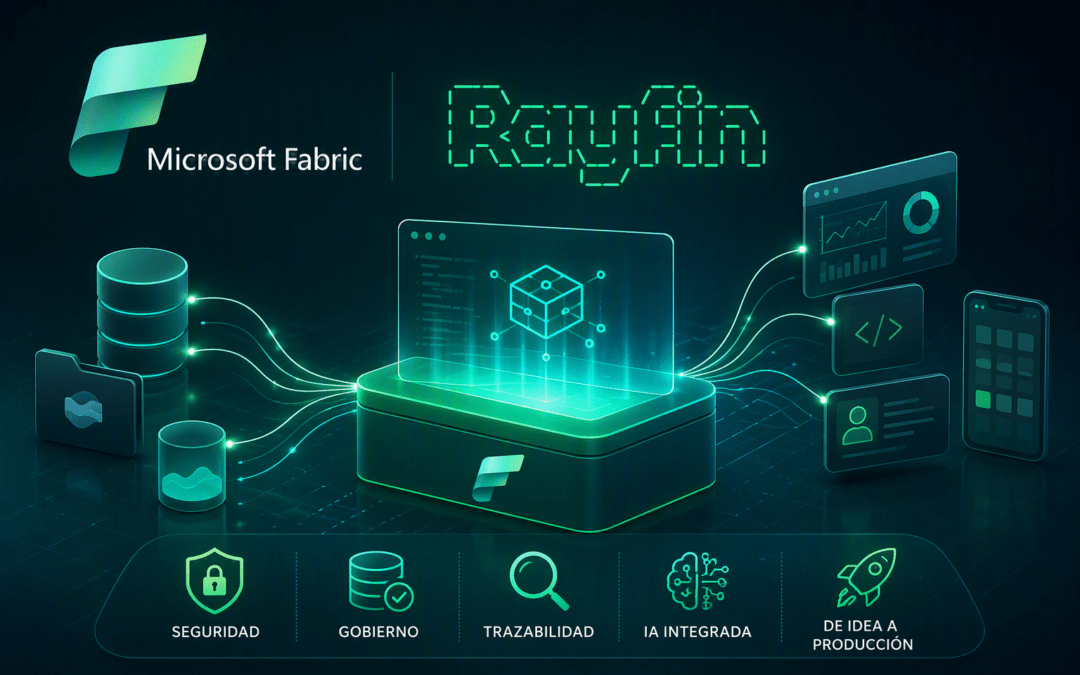
Rayfin is the new capability from Microsoft Fabric for create lightweight applications regarding the company data.
In this article we explain what it is, what it is not, and when it makes sense for an organisation.
Executive summary:
What is it: a new feature of Microsoft Fabric (still in the phase of test/preview) which allows create small web applications connected to company data, much faster and without setting up new infrastructure.
What it is NOT: it is not an alternative to an ERP, a CRM, or a business management system. It is not designed for complex business processes.
Why it matters: allows companies that already use Power BI and Fabric take it a step further: turn your data and reports into your own interactive applications, without relying on new vendors or losing control over information security.
What it requires: capacity of Fabric contracted, IT enablement, and technical profiles to develop them (it is not a «no-code» tool for business users).
What is Rayfin, explained without technical jargon?
Microsoft Fabric is the platform where many companies already centralise their data, their reports Power BI and, increasingly, its artificial intelligence. Until now, that platform was mainly used for analyse information: view dashboards, explore data, generate reports.
Rayfin is the technical name of a new capability —commercially called «Fabric Apps«— which allows you to go a step further: building small web applications (internal portals, forms, team tools) that connect directly to that same data, without having to hire or maintain separate servers, databases or user systems. Microsoft takes care of all that infrastructure automatically.
In other words: it is a faster and more cost-effective way of turning an idea into a functional application, provided that application revolves around data and analytics.
The most common misunderstanding
Some of the early articles on this novelty have suggested that Rayfin it would make it possible to create any kind of business management application: project tracking, incident management, bespoke CRM, etc. Official Microsoft documentation does not support that reading.
Microsoft he is explicit in pointing out that this technology is designed, above all, for rapid prototyping, internal tools, data exploration and artificial intelligence applications — and that may not be suitable for applications with complex transactional processes (for example, multi-step approval workflows, or deep integrations with existing management systems).
This has an important practical implication for any decision-maker: Rayfin is not a competitor to Power Apps, Dynamics 365 or custom development for management processes. It is, rather, a natural extension of the investment that many companies have already made in Power BI and Fabric, to better express those data with proprietary applications.
When does it make sense to evaluate it in my company?
| ✅ It makes sense to use Rayfin | ❌ Better look for another solution |
| Create an internal portal or a data dashboard for a team, quickly and without waiting for IT | Replacing an existing ERP, CRM or process management system |
| Give to a model of Power BI already existing bespoke application experience | Automate complex approval workflows or processes with many dependencies |
| Build a simple app data capture (forms, task lists) | Integrate transactionally with legacy systems or stored procedures |
| Providing a user interface to an AI agent that needs to remember information | Provide access to external users with identity systems other than Microsoft |
What you should consider before adopting him
- It's in preview. Microsoft has not yet announced when it will be fully available with all guarantees, nor has it confirmed the final cost model.
- Requires purchased Fabric capacity and that the IT department explicitly enables it; it does not work with the most basic Power BI licences.
- It is still a tool for technical profiles. It is not a «no-code» platform intended for a business user to build the application themselves, although it does greatly accelerate the work of a developer supported by artificial intelligence.
- Access security depends on corporate Microsoft accounts (Entra ID). This is a governance advantage, but it limits its use if you need to give access to external users with other types of credentials.
- Legal and compliance responsibility for the data that the application collects remains with the company, as with any other tool.
Recommendation
Our recommendation is to evaluate Rayfin like what it is: a fast and well-governed way to get things up and running small data applications —interactive panels, enquiry portals, lightweight internal tools— backed by the investment already made in Fabric and Power BI. It should not be seen as a replacement for more ambitious business management projects, for which other Microsoft platform solutions (Power Apps, Dynamics 365) or custom development remain more appropriate.
The right decision is not «whether or not to adopt Rayfin», but rather identify which specific use cases in your organisation fit this profile, and prioritise them within a broader data strategy.
🚀 How can Next Step help?
We At Next Step we help management teams make these kinds of technological decisions with discernmentwhat tool to use for each need, what investment makes sense and in what order, and how to avoid both paralysis by an excess of novelties and the premature adoption of as yet immature technologies. If your company already works with Power BI o Microsoft Fabric, we can help you assess whether Rayfin it fits into their roadmap.
Let's talk about your data and AI strategy.
Sources: official Microsoft Learn documentation on Fabric Apps and the Rayfin SDK, and the official Microsoft announcement at Build 2026.