From the AI that answers to the AI that executes
The artificial intelligence the company is entering a new stage. Up to now, the majority of organisations have worked with copilot-type assistants: tools that respond, suggest or generate content on demand.
But Microsoft has just taken another step with a new category of agents called Autopilots, designed to work continuously, autonomously and with real business context.
The first example is Microsoft Scout, an “always-on” agent capable of understanding how work flows between applications and acting on behalf of the user within organisational policies.
The implication is clear: we are leaving behind the “I ask and the AI answers” logic to enter a model in which the AI observe, decide and execute.
What are Autopilot Agents and why they are game changers
The Autopilot Agents represent a new layer within the ecosystem Microsoft.
Copilot vs Autopilot: main differences
- Copilot → responds to requests
- Autopilot → executes complete tasks
- Copilot is reactive
- Autopilot is proactive
- Copilot works by interaction
- Autopilot works by continuity
👉 The key shift: we are moving from assistants to operational agents.
From reactive assistants to proactive agents
The Autopilots They don't wait for constant instructions.
- Action opportunities are detected
- They identify pending tasks
- They execute processes automatically
This makes them a natural evolution towards intelligent work automation.
The concept of persistent identity in AI
Each Autopilot:
- It has its own identity
- Operates under defined permissions
- Learn from user behaviour
👉 This allows for traceability, control and real personalisation.
Microsoft Scout: the first autonomous Microsoft 365 agent
Microsoft Scout inaugurates this new category of agents.
What is Microsoft Scout and how does it integrate into Microsoft 365
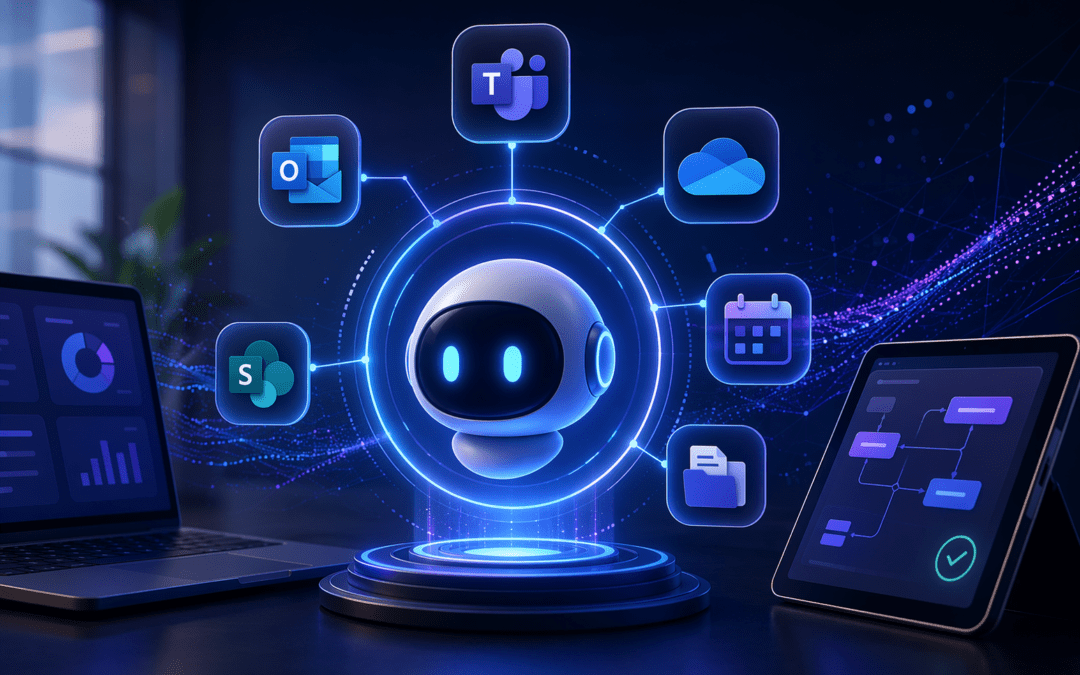
Scout is an agent fully integrated into:
- Microsoft Teams
- Outlook
- OneDrive
- SharePoint
Work directly on:
- Emails
- Meetings
- Chats
- Documents
- Contacts
👉 That is to say, about the real business context.
Connected apps: Teams, Outlook, OneDrive and SharePoint
Native integration allows:
- Read and generate emails
- Prepare meetings
- Analyse documents
- Coordinate tasks
All without leaving the Microsoft 365 environment.
Always-on capabilities: continuous work without prompts
Scout's big difference:
- It is always active
- It doesn't need to be constantly invoked
- Maintain the context of the work
👉 It works like a persistent assistant, not as a chatbot.
How Autopilot Agents work at a technical level
Behind this capability lies an advanced architecture based on context, reasoning, and action.
Access to context via Microsoft Graph
The agent accesses:
- Emails
- Documents
- Calendar
- Conversations
👉 This allows you to understand the operational reality of the company.
Multi-step task orchestration
The agents:
- They break problems down into steps
- They decide the execution order
- Coordinating actions between tools
👉 They don't solve a task, they solve a complete process.
Integration with external systems using MCP
Thanks to Model Context Protocol (MCP):
- They connect to APIs
- They interact with external tools
- They execute processes outside Microsoft 365
👉 This makes them system orchestrators, not just internal assistants.
Agentic AI architecture at Microsoft: context, reasoning and action
OpenClaw as a basis for agents
Microsoft Scout is built on OpenClaw, an open-source framework for autonomous agents.
Work IQ: enterprise contextual intelligence
Work IQ enables:
- Understanding priorities
- Detect work patterns
- Anticipate necessary actions
👉 It's what makes the agent genuinely “intelligent”.
Hybrid execution: cloud, desktop and browser
Scout can operate:
- In the cloud
- On the desktop
- In the browser
👉 This gives you access to multiple workspaces simultaneously.
Security, identity and governance in autonomous agents
One of the key aspects in business.
Agent's own identity (Entra ID)
Each agent:
- It has its own identity
- Act on behalf of the user
- Respect permissions and policies
Permission and policy control
The organisation defines:
- What the agent can do
- What data do you access
- What actions can you carry out
Supervision and validation (human-in-the-loop)
- Critical actions require validation
- There is complete traceability
- Human control is maintained
👉 Autonomy yes, but governed.
Case study: pre-sales automation with agentic AI
Current issue in presale processes
In a consultancy like Next Step:
- Check contact emails
- Select the leads
- Search documentation
- Prepare proposals
- Coordinating meetings
👉 It involves a lot of sales effort
Automated workflow with Autopilot Agent
We have automated part of our sales activity with an agent:
- Detect an email with an opportunity
- Analyse the customer context
- Search for similar proposals and cases
- Generate a draft proposal
- Suggest response and next action
👉 Everything with minimal intervention.
Impact on commercial productivity and efficiency
- Reduction of presale time
- Faster response speed
- Better use of internal knowledge
- Standardisation of discourse
As a sales team, we have reduced the time spent selecting and replying to emails and preparing proposals, which we can now dedicate to looking after customers and making valuable decisions.
What this implies for businesses: opportunity and preparation
Data preparation and governance
No organised data:
- The agent doesn't understand context
- The quality of results falls
Definition of use cases
It is key to start with:
- Repetitive processes
- Knowledge-intensive tasks
- Scenarios with clear ROI
Progressive evolution towards real automation
Recommended phases:
- Copilot assistance
- Semi-autonomous suggestion
- Controlled execution (autopilot)
Conclusion: towards a new digital workforce
Autopilot Agents mark a structural shift in the way we work.
We are no longer talking about tools that help, but systems that:
- They understand the context
- They make decisions
- They perform tasks
This opens the door to a new reality: the AI-agent-based digital workforce.
Organisations that know how to adopt this model with discernment will not only gain efficiency, but will transform their way of operating.
🚀 Next Step we help you make the move to Agentic AI
We At Next Step we help organisations take this step towards agentic AI:
- Identifying real-world use cases
- Preparing the Microsoft 365 environment
- Designing secure architectures
- Deploying agents with a business impact
👉 Do you want to explore how to apply Autopilot Agents in your company? Let's talk.
Contact | Next Step Consultants