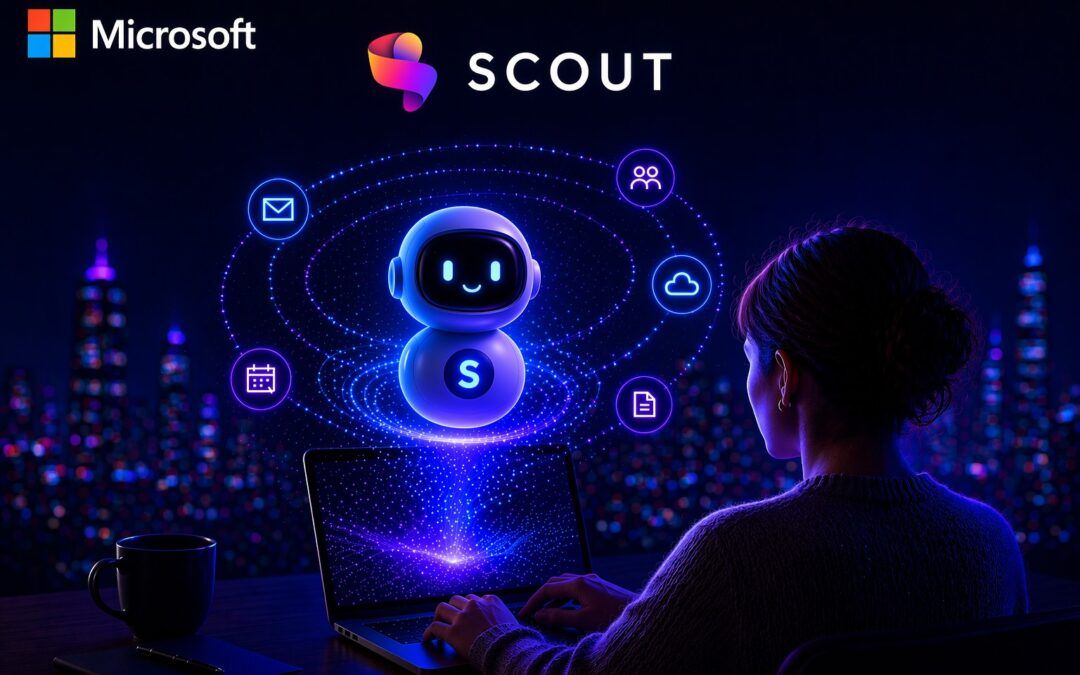
Microsoft has introduced Scout, the first agent Autopilot from Microsoft. A new generation of always-on AI agents, capable of acting autonomously on behalf of the user and integrated into Microsoft 365.
🤖 What is Microsoft Scout?
Microsoft Scout he is the first agent Autopilot of Microsoft, an AI system that remains active in the background and can act on behalf of the user, within the limits and permissions defined by the organisation. According Microsoft, its objective is to reduce the coordination, monitoring and management tasks that consume a large part of professionals' time.
Unlike a traditional co-pilot, which responds when assistance is requested, Scout work continuously:
- Detect pending actions.
- Identify risks or blockers.
- Coordinate meetings.
- Manage calendars.
- Prepare relevant information for daily work.
- Follow up on tasks and commitments.
In other words, we are moving from an AI that answers questions to an AI that take the initiative while keeping the user informed and in control.
🚀 From copilots to «Autopilots»
The appearance of Scout marks a significant evolution within the strategy of Microsoft AI.
Until now, tools like Microsoft 365 Copilot they helped to create documents, summarise meetings or analyse data. The user initiated the interaction and the AI responded.
With Scout, Microsoft introduce the concept of Autopilot, agents capable of:
- Operate persistently.
- Maintain long-term context.
- Act across multiple applications.
- Execute tasks without the need for new instructions.
- Working under corporate policies and enterprise security controls.
This approach fits fully with the evolution towards Agentic AI, where systems not only generate responses, but actively collaborate in business processes.
🔗 An agent connected to the entire Microsoft ecosystem
One of the main competitive advantages of Scout is its native integration with Microsoft 365.
The agent can work with:
- Microsoft Teams
- Outlook
- OneDrive
- SharePoint
- Calendar
- E-mail address
- Chats
- Corporate contacts
In addition, Microsoft has announced that Scout can be extended to the browser, local resources and servers compatible with Model Context Protocol (MCP), expanding its ability to interact with external tools.
This level of integration is especially relevant because it allows the agent to have real context on how each user works and on the processes that are carried out within the organisation.
📅 What tasks can it perform?
Although it is in an initial phase and part of Microsoft's Frontier programme, several use cases are already known.
Scout can:
- Automatically organise meetings, coordinating schedules among participants, detecting diary conflicts and proposing alternatives.
- Prepare meetings, generating background information, gathering relevant context and highlighting key points before each meeting.
- Manage working time, detecting upcoming deliverables and blocking out time in the calendar to complete them.
- Identify risks and blockers, recognising stalled decisions, pending tasks or bottlenecks that may affect the progress of projects.
- Keep a continuous track, accompanying the execution of the work without the need to receive constant reminders or instructions.
Security and governance by design
One of the most interesting aspects of Microsoft Scout it's just that it was designed for corporate environments.
Microsoft highlights that each agent has its own identity governed within Microsoft Entra ID and operates under the organisation's security and compliance policies.
This represents a significant change compared with other, more general-purpose AI assistants:
- Actions are traceable.
- Permits are limited.
- Compliance checks are carried out.
- Sensitive operations may require human approval.
Safety and oversight remain key elements in any agent-based AI strategy, something we had already highlighted as one of the critical success factors for organisations.
🌟 Why is it so important for businesses?
The true importance of Scout lies not only in its current features, but in the paradigm shift it represents.
We are witnessing the transition from:
AI that helps → AI that collaborates → AI that acts.
Organisations have spent years looking to automate processes, reduce repetitive tasks and increase productivity. Autonomous agents take this evolution a step further by combining reasoning, context and execution capability within everyday working environments.
However, success will not depend solely on technology. As with any agentic AI initiative, it will be necessary to define clear processes, establish governance mechanisms, integrate the agents with corporate systems and always maintain appropriate human oversight. These will be the keys to transforming the potential of agents into real business results.
🔬 Availability: currently in preview
Currently, Microsoft Scout It is only available to selected organisations within the programme Frontier.
To access Scout, you must be a member of Frontier and meet a number of configuration and corporate governance requirements. Microsoft states that organisations must enable certain policies via Intune and complete a voluntary opt-in process (opt-in). Furthermore, users need to have a compatible GitHub Copilot licence to install and test the solution. Further information is available on Microsoft’s official website: Microsoft Scout documentation | Microsoft Learn
This limited availability reflects the fact that the technology is still at an early stage of adoption by businesses. Nevertheless, it gives an indication of how productivity tools will evolve in the coming years and the direction Microsoft’s AI strategy is taking
🎯 Conclusion
Microsoft Scout is one of the most advanced examples of the new generation of autonomous AI agents. Its ability to understand the work context, continuously monitor tasks and act proactively points towards a model in which artificial intelligence will cease to be merely an assistive tool and become a genuine digital collaborator.
Although access to it is currently restricted to a small group of organisations within the Frontier programme, Scout It offers a very clear picture of what lies ahead: more automated working environments, less administrative burden and closer collaboration between people and intelligent agents.
The question is no longer whether autonomous agents will make their way into organisations. The real issue is how to prepare to successfully integrate them into business processes and turn them into a sustainable competitive advantage.
🚀 Next Step We help you successfully implement agent-based AI
We Next Step We help businesses identify opportunities for automation, design agent-based AI strategies and deploy intelligent agents within the Microsoft ecosystem.
¡Take the next step with us!
Contact | Next Step Consultants