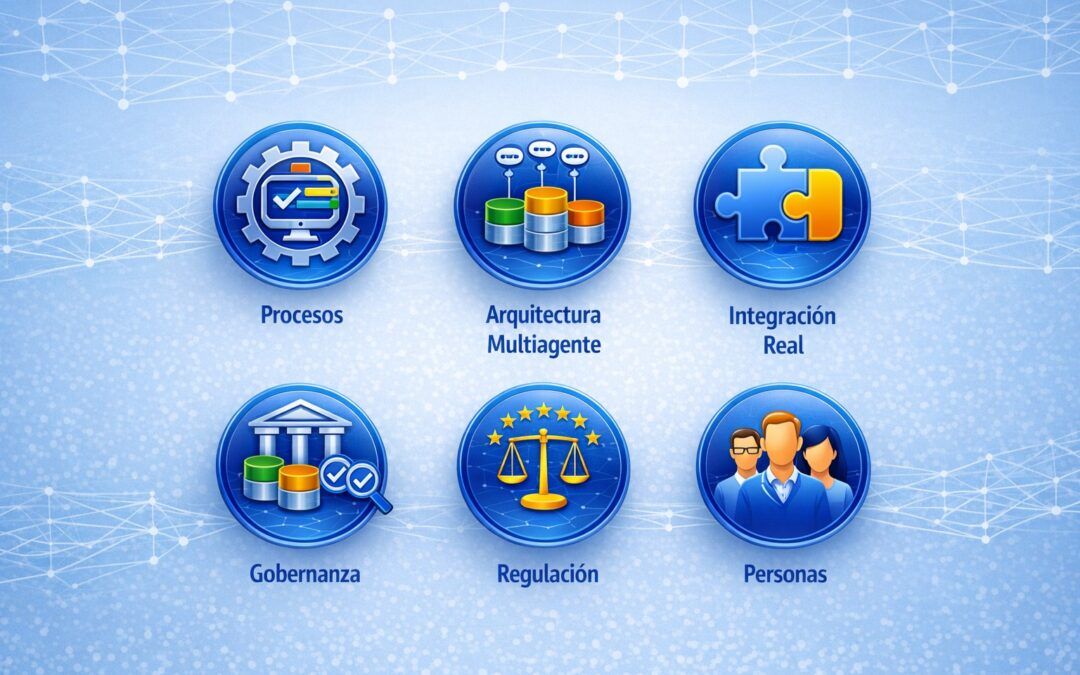
The 6 keys to success in agentic AI
Processes, multi-agent architecture, real integration, governance, people and legislation
In just a few months, agentic AI has gone from being a technological promise to becoming an operational reality in many organisations. However, not all companies are achieving the same results. While some are moving towards more autonomous and efficient models, others remain stuck in trials with no real impact.
In 2026, success in agentic AI doesn't depend on having the most advanced technology, but on how it is designed, integrated, and governed. These are the keys that are making a difference.
1. Think in processes, not agents
One of the most common mistakes in agentic AI projects is starting with the technology instead of the business. Many initiatives kick off by asking “what agent can we build” instead of “what process do we need to improve”.
Agentic AI works when applied to well-defined processes, with clear objectives and concrete success metrics. Without this approach, agents remain isolated demonstrations with no real impact.
Key ideas:
- Start with the process, not the tool
- Clearly define the business problem
- Establish success metrics from the beginning
- Deciding which tasks to delegate and which not to
Design multi-agent architectures, not monolithic solutions
In 2026 it has become clear that the model of “all-in-one agent” it doesn't scale. The most robust implementations opt for multi-agent systems, where each agent has a specific role and cooperates with others.
This approach allows greater control, better maintenance and simpler evolution of the system. The key lies in properly designing the collaboration between agents from the outset.
Key ideas:
- Specialised agents with clear responsibilities
- Orchestration and coordination between agents
- Avoid rigid and difficult-to-scale solutions
- Make the maintenance and evolution of the system easier
3. Real integration with business systems
An isolated agent, no matter how sophisticated, brings little value if it is not connected to the heart of the business. Agentic AI demonstrates its impact when it is integrated with corporate data, applications and platforms.
ERP, CRM, analytical systems, BI tools or platforms like Microsoft Fabric are the environments where agents can act with context and make useful decisions.
Key ideas:
- Connect agents with real enterprise systems
- Access reliable and up-to-date data
- Integrate with BI, ERP and CRM
- Moving from “smart” actions to business decisions
4. Governance, control and supervision by design
The greater the autonomy of the agents, the greater the control must be. By 2026, mature agentic AI projects incorporate clear mechanisms from the outset for human oversight, auditability and traceability.
Success does not lie in eliminating the human, but in correctly defining when they intervene and with what responsibility.
Key ideas:
- Define clear boundaries for the agent's operation
- Establish human supervision (“human in/on the loop”)
- Monitor decisions and behaviour
- Manage risks, costs and security
5. The most important: The organisational key: Human work must be redesigned
The fifth key, perhaps the most important and underrated, is the organisational one. Agentic AI doesn't just automate tasks: transform the way you work. Successful projects redefine roles, responsibilities and internal dynamics. People must be put at the centre.
Agents free up time for higher-value activities, but require equipped teams to oversee, decide and make the most of automation.
It is essential:
- Redefine roles and responsibilities
- Train teams to work with agents
- Focusing on AI as support, not substitution
- Focus on value and productivity
6. Incorporating the European regulatory framework as part of the strategy
In Europe, agentic AI cannot be designed independently of regulation. The European AI Act and the GDPR directly affect systems capable of acting autonomously on real data and processes.
The most advanced organisations already integrate regulatory compliance as an element of design itself, rather than as a subsequent addition.
Key ideas:
- Take the AI Act into account from the start
- Complying with the GDPR: data, purpose and traceability
- Designing transparent and auditable agents
- Build internal and external trust
Conclusion
Agentic AI is no longer a future trend, but a technology in the consolidation phase. In 2026, the differentiator will not be who adopts agents first, but who implants them best.
Success involves combining technology, data, processes, governance and people into a coherent strategy. Those organisations that understand this combination will be the ones that turn agentic AI into a real and sustainable competitive advantage.
🚀 Take the next step in Agentic AI with Next Step
We Next Step we help businesses to successfully implement artificial intelligence and AI agents, with a practical and results-oriented approach.
We are already working with real clients and active success stories based on these technologies.
👉 Take the next step with us! Speak to our experts.
Contact | Next Step Consultants