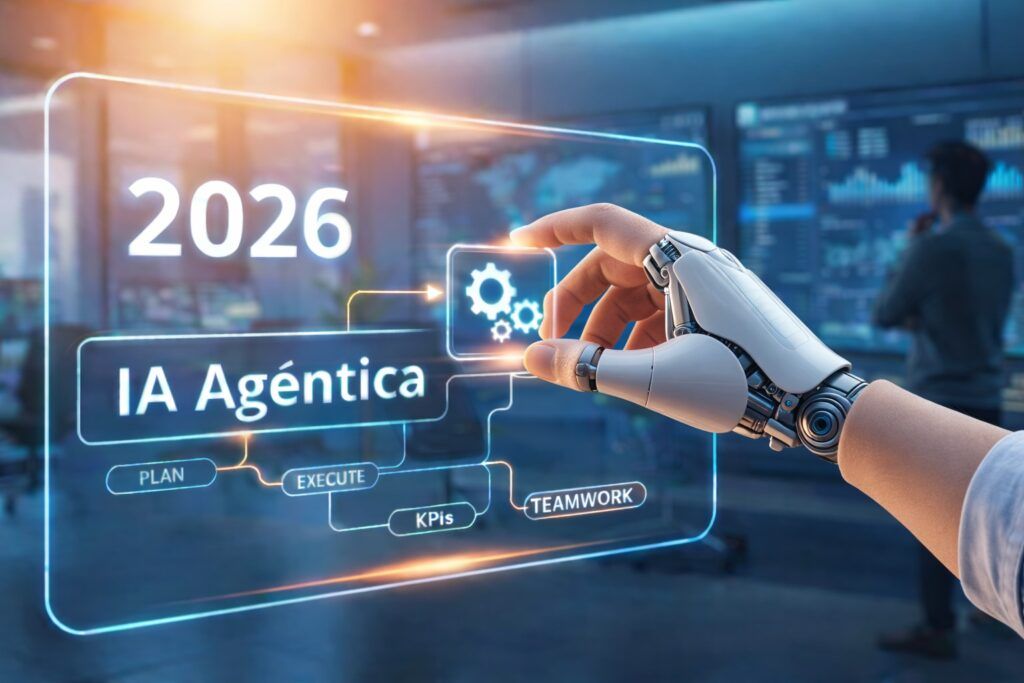
The new challenge of working hand in hand with AI
If 2025 marked the consolidation of generative artificial intelligence and the phase of experimentation with AI assistants, this year 2026 Agentic AI it will become a strategic priority for businesses.
According to a recent study by Gartnerthe 89 per cent of CIOs globally plan to increase spending on AI this year. Furthermore, the consultancy firm anticipated that until the 40 % of business applications will be integrated with AI agents task-specific by the end of 2026, compared with less than 5 % in 2025, which highlights a clear acceleration in the transition from individual assistants towards more autonomous and complex agent-based systems. The Agentic AI it is going to mark a turning point in the way we work, lead and make decisions. Because these active agents not only execute tasks, but make decisions autonomously, coordinate processes, oversee results and have to be integrated into teams and work with people on a day-to-day basis. We are no longer talking about using AI, but about coexisting and collaborating with agents within teams.
This raises a key question: Are we ready to work side by side with AI agents?
From assistants to agents: the great leap
Up to now, most AI solutions worked like reactive toolsthe user asks, the AI answers. Agentic AI break that mould.
An AI agent:
- It has defined objectives.
- It can plan actions.
- Execute tasks without constant supervision.
- Interacts with other systems and agents.
- Learn from the context and the history.
In 2026, this type of agent is beginning to be integrated into enterprise platforms, especially in environments of data, business intelligence, automation and operations, where volume and complexity make purely human management unviable.
Trend 1. Specialised agents by business function
The first major trend is the specialisation. Instead of a generic AI, organisations are beginning to deploy specialised agents in specific roles:
- Data analysis and business intelligence agents.
- Financial control officers.
- Operational monitoring agents.
- Internal support agents.
- Planning and forecasting agents.
These agents do not replace an entire department, but they do they take on complete tasks within a function, reducing times, errors and reliance on manual processes.
Trend 2: Multi-agent systems: when AI works in a team
By 2026, AI agents no longer work in isolation. They are beginning to operate in multi-agent systems, where several agents:
- Tasks are being distributed.
- They exchange information.
- They validate each other's results.
- They coordinate complex actions.
This approach makes it possible to tackle problems that no single agent could solve on its own and brings AI closer to working dynamics similar to those of a human team.
Here a key idea emerges: AI does not only collaborate with people, it also collaborates with itself.
Trend 3: Supervisory agents: AI is also in control
One of the most disruptive evolutions of Agentic AI it is the appearance of agents with supervisory functions. These agents do not execute final tasks, but rather:
- They monitor the work of other agents.
- They validate compliance with rules and objectives.
- They detect anomalies or deviations.
- They generate alerts and escalate incidents.
In certain contexts, they can even supervise processes carried out by people, by analysing compliance, results or patterns of behaviour.
This automates a large part of operational control and shifts the human focus towards judgment and decision-making.
Trend 4. Deep integration with data and Business Intelligence
The Agentic AI finds its natural home in data. The agents:
- They access unified data platforms.
- They interpret semantic models.
- They analyse information in real time.
- They propose evidence-based decisions.
In Business Intelligence environments, this represents a radical change: agents do not merely generate reports, but rather They continuously monitor the business, they detect opportunities and risks, and act or raise the alarm before anyone asks.
Business Intelligence ceases to be a query tool to become a living, proactive and action-oriented system.
Trend 5. Governance, security and trust as an essential condition
With greater autonomy comes greater responsibility. The expansion of the Agentic AI 2026 brings clear risks if not managed correctly:
- Opaque decisions.
- Amplified biases.
- Loss of human control.
- Regulatory conflicts.
Therefore, another major trend is the strengthening of AI governance. Organisations are starting to define:
- What decisions an agent can make and which ones it cannot.
- What data can you use.
- How their behaviour is audited.
- When a person should intervene.
In 2026, there will be no viable agentic AI without clear rules, traceability and human oversight.
Trend 6. The direct impact on people and leadership
The Agentic AI It not only transforms processes, but also transforms roles. Some jobs will disappear, others will be redefined, and many professionals will see their capabilities amplified. But everyone will have to learning to work with AI agents.
The role of department heads will be particularly important; they will be required to:
- Managing mixed teams of humans and agents.
- Deciding what to delegate and what not to.
- Interpret AI-generated recommendations.
- Take ultimate responsibility for the decisions.
Leadership in 2026 is no longer just about managing people, but about govern hybrid systems.
How to start and at what cost? From reflection to action
The Agentic AI it is not just within reach for large corporations with multi-million pound budgets. The technology already exists and is available for businesses of all sizes. The difference between organisations that move forward and those that fall behind will not lie so much in their budget or size, but in once they start implementing this technology and the strategy they adopt from the beginning.
How to get started with Microsoft: Creating and integrating AI agents
Microsoft is building an ecosystem where the Agentic AI integrates directly into business working tools, data and processes, with no need for complex developments from scratch.
The key tools are:
- Microsoft 365 Copilot
Agents integrated into daily applications (Outlook, Teams, Excel, etc.) that automate tasks, analyse information and support decision-making within the workflow.
- Copilot Studio
The essential tool for design, customise and manage AI agents, defining its behaviour, objectives, data sources and integrations.
- Microsoft Fabric and Power BI
They provide the databases and analytics so that staff can work with corporate information in a standardised, governed and traceable manner.
- Power Automate and Power Apps
They enable agents to be deployed in live operations, integrating them into business processes and applications under human control and supervision.
This approach makes it easier to start with simple cases and progressively evolve towards more autonomous agents, in line with the business objectives.
Getting started with Google: AI agents on advanced models and data
Google follows a similar strategy, focused on combining advanced models, data and agent orchestration within its cloud platform.
The main components are:
- Gemini
Google’s family of AI models, which forms the basis for agents capable of reasoning, generating content, analysing information and maintaining context.
- Vertex AI
The Google Cloud platform for create, train and deploy models and agents, including agent-based workflows and integration with enterprise systems.
- Multi-agent systems and orchestration
They enable the creation of agents that collaborate with one another and act in a coordinated manner within complex processes.
- Integration with cloud data
The agents work directly on corporate data stored in Google Cloud, enabling advanced analytics and automation.
The cost: more affordable than it seems (if done sensibly)
In 2026, agent-based AI will no longer rely on large-scale, bespoke projects. Many capabilities are being incorporated as additional layers on top of existing tools, with scalable pricing models based on usage and impact.
This means that so that small and medium-sized enterprises can also get started, provided that:
- Make sure the use cases are chosen carefully.
- Priority should be given to processes that have a real impact.
- The scope should be controlled from the outset.
The greatest risk is not investing too much, but investing without criteria or strategy.
Conclusion: agentic AI will redefine the way we work
The Agentic AI will redefine how many companies work. AI agents will start to become real actors within organisations, with the capacity to execute tasks, supervise processes and coordinate work in an increasingly autonomous way.
Companies that understand this change and tackle it with strategy, governance and cultural readiness, they will be able to multiply their productivity and improve their decision-making capacity. Those that ignore it—or adopt it without discernment—will take on unnecessary risks and lose competitiveness.
The real challenge is not technological, but organisational: prepare businesses to operate and make decisions in environments where people and AI agents share responsibilities and work together. In this new scenario, the advantage will not lie in who adopts the technology first, but in whoever knows how best to integrate it into their way of working, leading and making decisions.
🚀 Next Step We can help you
Next Step We support organisations that want to introduce the Agentic AIhelping them to identify real-world use cases and integrate it sensibly, progressively, securely and in alignment with business objectives!Take the next step with us! Contact | Next Step Consultants