💡 How to choose the ideal platform according to your company's needs
Artificial intelligence has experienced more advances in the last three years than in the previous two decades. In 2025, the pace of innovation is so rapid that a new version of models such as GPT, Llama, Mistral, Grok or DeepSeek is released every quarter, completely changing the technological landscape. Companies, regardless of their size or sector, now find themselves facing a strategic decision how to integrate AI into your processes, which platform to choose, how to ensure regulatory compliance and how to scale without compromising security or efficiency.
Two platforms stand out especially in that scenario: Azure AI Hub —inside the suite Azure AI Studio / Azure AI Foundry— y OpenAI, the creator platform of ChatGPT. Both have evolved enormously since 2023 and today offer capabilities that only a few years ago seemed like science fiction: models with advanced reasoning, real multimodal comprehension, planning, tool use, image and video generation, integration with autonomous agents, and long-term memory capabilities.
This article offers you a full and up-to-date comparison to help you make informed decisions about which platform best fits your company's needs in 2025 and the coming years.
1. The new AI context in 2025: why platform choice matters more than ever
In 2025, businesses are in one of these three phases:
- Exploration: experiment with AI on a small scale (chatbots, one-off automations, internal assistants).
- Industrialisation they deploy AI projects into production, with a real impact on critical processes.
- Strategic scaling: integrate AI across the organisation, with governance, security, centres of excellence and mature data pipelines.
The platform you choose determines:
- The ability to comply with regulations such as GDPR or NIS2.
- The speed of innovation.
- The total cost of ownership (TCO).
- Integration with existing systems.
- The variety and quality of models available.
- Security, traceability and governance.
In other words: the choice of platform not only affects the first AI project, but the entire future transformation strategy.
2. What is Azure AI Foundry and why it is Microsoft's strategic bet for enterprise AI
2.1. General definition
Azure AI Foundry it is Microsoft's unified platform for building, managing, evaluating and deploying generative and traditional AI solutions.
Combine into a single environment:
- Azure AI Hub (workspaces).
- Azure OpenAI.
- Model Catalog (featuring OpenAI, Meta, Mistral, xAI, Cohere models…).
- RAG-as-a-service.
- Prompt Flow.
- Model evaluation.
- Security, compliance and monitoring.
- Integration with Microsoft Fabric and Power Platform.
- Agent capabilities, pipelines, and deployments.
Yes OpenAI It's a powerful engine, Azure AI Foundry is the whole car, with steering wheel, brakes, controls, GPS and safety systems.
2.2. Azure AI Foundry architecture: how it works
Inside Foundry, the structure is organised like this:
- Azure AI Foundry – the entire AI platform
- AI Hub – secure workspace for grouping projects
- AI Projects – specific projects (RAG, co-pilots, chatbots, classifiers…)
- Models and resources – datasets, pipelines, endpoints, agents
This architecture allows medium-sized and large enterprises to:
- Centralise the AI.
- Control access.
- Apply corporate policies.
- Scale to tens or hundreds of use cases.
- Interoperate AI with critical data and systems.
2.3. An incomparable model catalogue (2025)
The strongest advantage of Azure AI Foundry is that it does not rely on a single supplier. In 2025, Foundry offers models of:
OpenAI
- GPT-5.1
- GPT-4.1
- DALL·E 3
- Whisper V3
- o-series (advanced reasoning)
Meta
- Llama 3, Llama 3.1
- Llama Guard (security)
Mistral AI
- Mistral Large
- Mixtral
- Nemo
xAI
- Grok-1
Cohere
- Command R
- Command R+
Others
- Open source models from Hugging Face
- Vision AI
- Voice models and embeddings
In other words:
👉 With Foundry, your company has a full range to choose the optimal model according to cost, latency, accuracy, and security.
2.4. Key advantages of Azure AI Foundry
✔ 1. GDPR compliance and data residency in Europe
Azure allows:
- Processing 100% ((processing, storage, inferences, logs, backups, telemetry, etc.) within the EEA (European Economic Area)
- EU Data Boundary / EU Data Zone
- Full data flow control
- Full traceability and audit
- Advanced end-to-end encryption
For regulated sectors (banking, energy, healthcare, public administration), this capability is essential.
✔ 2. Corporate governance and security
Azure AI Foundry integrates with:
- Microsoft Entra ID (Azure AD)
- Corporate policies (RBAC, PIM)
- Auditing in Azure Monitor and Log Analytics
- Private networks, VNETs, firewalls
- Security controls aligned with ISO 27001 and the AI Act
This allows AI to be managed as a corporate asset, not as isolated experiments.
✔ 3. Native integration with the Microsoft ecosystem
Foundry integrates seamlessly with:
- Microsoft Fabric
- Power BI / Power Automate / Power Apps
- Dynamics 365
- SharePoint
- Azure SQL, Azure Cosmos DB
- Copilot and Copilot Studio
This reduces time, complexity and cost.
✔ 4. RAG-as-a-Service and production-ready AI pipelines
Foundry includes tools for:
- Build a robust and secure RAG
- Create business agents
- Implement automated assessments
- Prepare deployments at scale
- Establish good MLOps/LLMOps practices
OpenAI offers models, but Foundry offers the complete architecture.
2.5. Disadvantages of Azure AI Foundry
- Greater initial complexity.
- Higher cost if the project is small or one-off.
- Requires knowledge of Azure and cloud architecture.
Foundry isn't the ideal platform for “trying out small things”, but rather for doing AI properly.
3.- What is OpenAI: the fastest, simplest and most experiment-oriented platform
OpenAI it has established itself as the generative AI standard for individuals, SMEs and agile innovation teams.
3.1. What OpenAI offers
OpenAI provide:
- ChatGPT (Plus, Team, Enterprise, Edu).
- OpenAI API for developers.
- Advanced models (GPT-5.1, GPT-4.1, o-series…).
- Image generation (DALL·E 3).
- Transcription and translation (Whisper V3).
- Multimodal capabilities for text, image and audio.
That's the way more direct of accessing advanced AI without infrastructure.
3.2. Newer OpenAI models (2025)
GPT-5.1 (Thinking / Instant)
- deep reasoning
- Instant: speed and low cost
GPT-4.1 and GPT-4.1 mini/nano
- High performance for general tasks
o-series models (o3, o4-mini)
- Specialised in structured reasoning
3.3. Key advantages of OpenAI
✔ 1. Speed and simplicity
Any business can get started in minutes.
✔ 2. Competitive prices
Ideal for:
- SMEs
- small automations
- prototypes
- low-risk projects
✔ 3. Early access to new models
The models are coming out first at OpenAI and then on Azure.
✔ 4. A vast developer ecosystem
Thousands of examples, SDKs and ready-to-use resources.
3.4. Disadvantages of OpenAI
- Weak governance compared to Foundry.
- Limited integration with Microsoft (always via API).
- GDPR compliance depends on the plan (which is not always suitable for regulated sectors).
- There is no centralised control over permissions, audits or data flows.
4. Direct comparison: Azure AI Foundry vs OpenAI
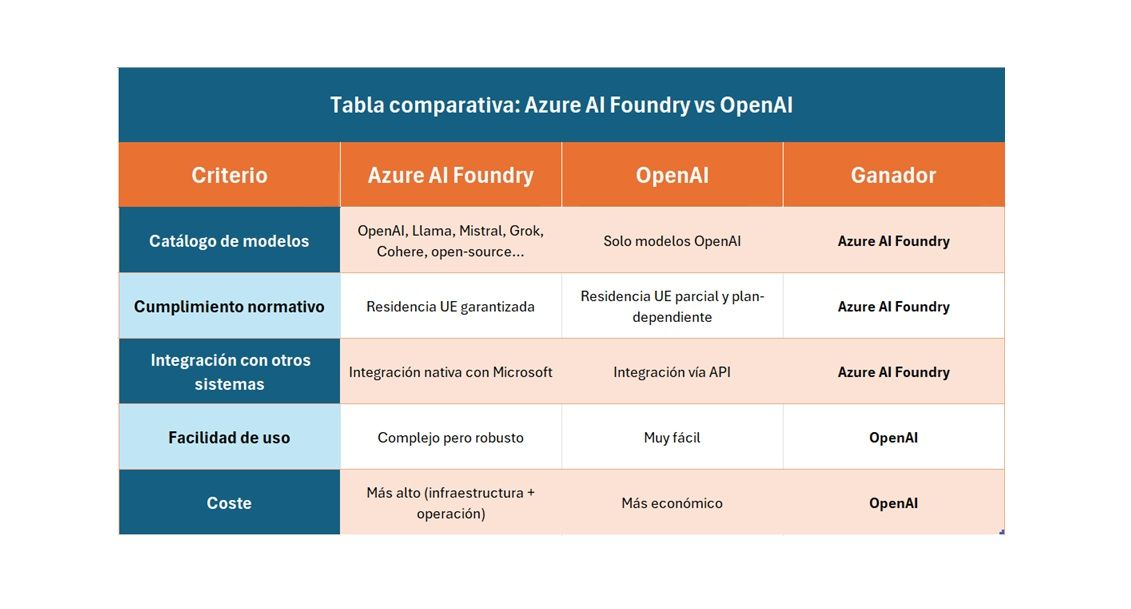
As we can see from the table, OpenAI It is the best choice, as it is easier to implement and more cost-effective (depending on the circumstances). On the other hand, Azure AI Foundry It offers a wider range of models, native integration with all Microsoft applications and greater compliance with data security regulations in Europe.
Winner: it depends on the case.
5. Real-life scenarios for choosing one or the other
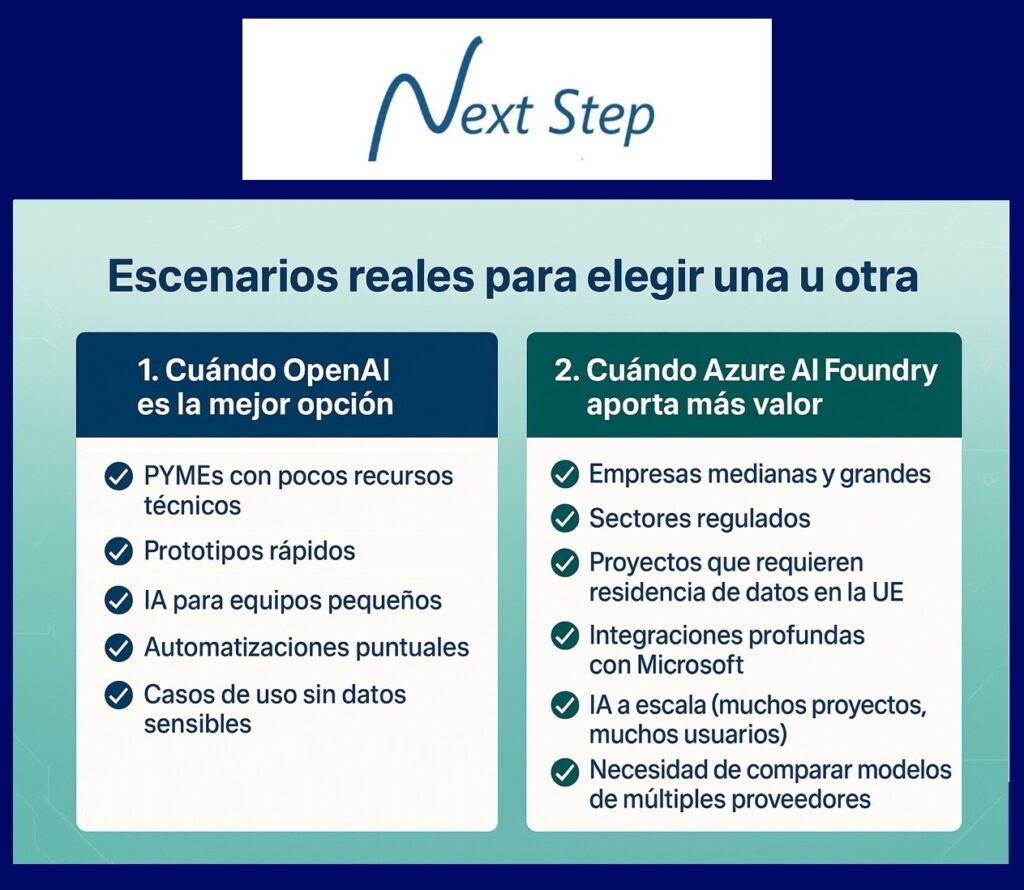
5.1. When OpenAI is the best choice
- Rapid prototyping.
- AI for small teams.
- One-off automation tasks.
- Use cases without sensitive data.
- SMEs with limited technical resources.
Examples:
- Content generators.
- Text classification.
- Basic chatbots.
- Automatic email analysis.
5.2. When Azure AI Foundry delivers the most value
- Medium-sized and large companies.
- Regulated sectors.
- Projects that require data to be stored within the EU.
- Deep integrations with Microsoft.
- AI at scale (many projects, many users).
- Need to compare multi-vendor models.
- Long-term AI strategies.
Examples:
- Secure corporate RAG.
- Internal co-pilots connected to private data.
- Large-scale document automation.
- Business agents with permission control.
5.3. Hybrid approach: the best option in 2025
Most organisations adopt a blended model:
- OpenAI for innovation and rapid testing.
- Azure AI Foundry for production, integrations and compliance.
6. Azure OpenAI: the best of OpenAI within the secure Azure environment
Azure OpenAI allows:
- Run OpenAI models within Azure.
- Corporate control with Entra ID.
- Private networks and VNets.
- Logging and auditing.
- Full GDPR compliance.
It is the preferred option for companies that want GPT-5.1 but with enterprise-grade security.
7. Conclusion: the choice depends on your strategy, not just on the technology
There is no such thing as “the best universal platform”.
OpenAI stands out for:
- Speed
- Simplicity
- Good price
- Instant access to the latest news
Azure AI Foundry stands out for:
- Governance
- Compliance
- Wide variety of models
- Integration
- Scalability
- Security
The combination of both is the dominant strategy in European companies in 2025.
8. How Next Step helps your company adopt AI securely and scalably
🧠Next Step we help you from start to finish:
- AI strategy definition
- Model selection (GPT-5.1, Llama, Mistral, Grok…)
- Implementation of RAG and copilots
- Secure architecture in Azure
- GDPR compliance
- Training and adoption
- AI scaling and corporate governance