
Leading companies are building their business model on artificial intelligence
Currently, many companies use the artificial intelligence as a tool to optimise specific tasks or improve efficiency.
However, the organisations leading the market have gone a step further: they are building its business model on AI. In this new scenario, the Agentic AI not only automates, but also redefine the way we work, make decisions and scale organisations, becoming a structural element of the business rather than mere technological support.
Microsoft he has given a name to this new business model: Frontier Firm.
What is a frontier firm?
According to Microsoft, a Frontier Firm is an organisation that integrates AI in a way that in-depth, cross-cutting and strategic in their day-to-day operations.
We’re not talking about companies “with AI”, but rather companies defined by AI.
In these organisations:
- AI plays an active role in key business processes
- AI agents act as autonomous collaborators
- Decisions are based on real-time data
- Productivity ceases to depend exclusively on the number of people
Microsoft points out that companies at the forefront of this advanced adoption of AI are reaping the benefits of results up to three times higher compared to those that use it on an ad-hoc or experimental basis, especially when AI is integrated across multiple business areas.
The key role of agentic AI
The great enabler of Frontier Firms is the Agentic AI.
Unlike traditional assistants, AI agents:
- They include objectives
- They carry out tasks independently
- They interact with systems, data and people
- They learn and adapt to their surroundings
This makes it possible to automate not only individual tasks, but end-to-end processes, always maintaining human supervision when necessary.
Microsoft defines it as a a new model of collaboration:
Human + Agent, no Human vs AI.
AI does not replace human talent; it enhances it.
Real results: it’s not just theory, it’s business impact
Microsoft analysed how the Frontier Firms are generating real and measurable value. The data shows that these organisations are achieving significant improvements in key areas such as:
- Brand differentiation
- Operational efficiency
- Revenue growth
- Customer experience
Companies like Levi Strauss & Co., ABB or Land O’Lakes they are already using integrated AI in their operations to reduce times, optimise processes and accelerate decision-making. In many cases, more than two thirds of these organisations are already monetising directly AI use cases in your business.
This confirms a key idea: The competitive advantage no longer lies solely in adopting AI, but in how it is integrated into the business model.
Microsoft as an example: becoming its own “Customer Zero”
Microsoft not only defines the concept of Frontier Firms, but also applies it internally.
Their own IT team, known as Microsoft Digital, is transforming the company towards a model AI-first, in which the AI agents They act as genuine “digital colleagues”.
These AI agents:
- They support staff in their day-to-day work
- They carry out tasks independently
- They operate in accordance with clear principles of governance, security and control
This approach enables Microsoft experience first internally what it then offers to its clients, reinforcing the idea that Frontier Firms they are not a theoretical concept, but rather a proven operating model.
A new role emerges: the Head of Agents
In this new context, a key figure appears: the Head of Agents.
This is not a purely technical role, but a strategic one. Their role is:
- Designing how people and AI agents collaborate
- Determine which decisions are delegated to AI
- To ensure control, ethical conduct and alignment with business objectives
This role reflects a profound shift: AI is already part of the team and needs leadership, coordination and business vision.
Frontier Firms vs traditional companies
LFrontier Firms represent a structural shift in the way companies compete.
The difference between this model and that of traditional businesses explains why some organisations will gain an advantage in the coming years… whilst others will lose it.
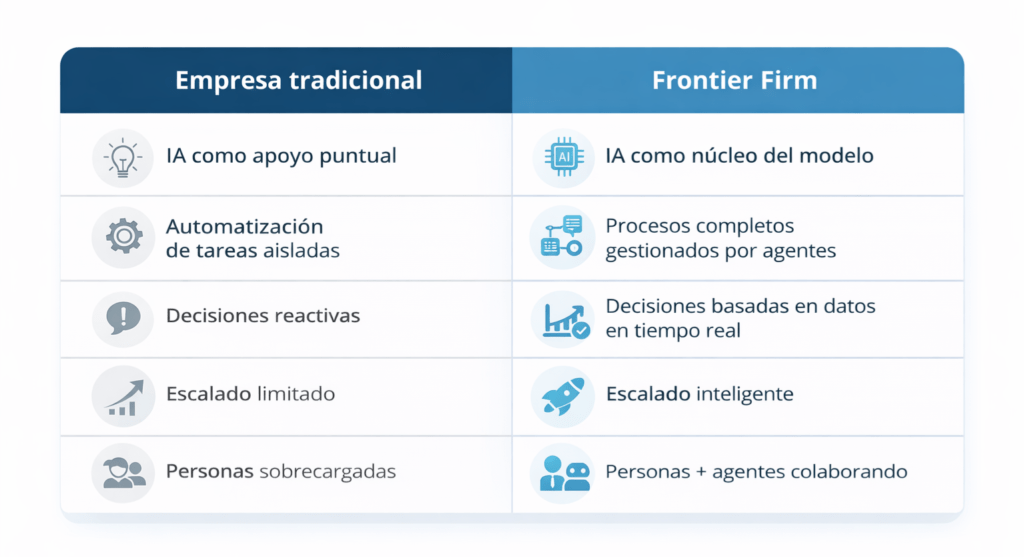
In the coming years, this difference will determine who leads the market and who loses their competitive edge.
How do you set out on the path to becoming a Frontier Firm?
To become a Frontier Firm It is not an immediate leap, but a gradual process that usually involves:
- Identify high-impact processes where AI can deliver real value
- Unify and govern business data
- Integrating AI agents into real-world workflows
- Preparing teams to work with AI
- Measuring results and continuously improving
The technology is already available. The real challenge is strategic and organisational.
Conclusion: AI is no longer just a promise; it is a business model
The Frontier Firms represent a new business model, in which artificial intelligence — and especially the Agentic AI— stops being a support tool to become the core of the way of working, deciding and scaling.
It is not a futuristic vision. It is a reality that is already making the difference between the companies that are leading and those that are falling behind.
Microsoft a name has been given to this change, but the responsibility now lies with each company: to decide whether it wants to lead this transformation or simply react.
Is your company ready to lead this change? The time to decide is now.
🚀 Next Step we can help you become a frontier firm:
Next Step we support organisations in this process in a way realistic and results-driven, combining strategy, data, automation and artificial intelligence applied to business.
Take the next step with us.