From the AI that answers to the AI that executes
The artificial intelligence the company is entering a new stage. Up to now, the majority of organisations have worked with copilot-type assistants: tools that respond, suggest or generate content on demand.
But Microsoft has just taken another step with a new category of agents called Autopilots, designed to work continuously, autonomously and with real business context.
The first example is Microsoft Scout, an “always-on” agent capable of understanding how work flows between applications and acting on behalf of the user within organisational policies.
The implication is clear: we are leaving behind the “I ask and the AI answers” logic to enter a model in which the AI observe, decide and execute.
What are Autopilot Agents and why they are game changers
The Autopilot Agents represent a new layer within the ecosystem Microsoft.
Copilot vs Autopilot: main differences
- Copilot → responds to requests
- Autopilot → executes complete tasks
- Copilot is reactive
- Autopilot is proactive
- Copilot works by interaction
- Autopilot works by continuity
👉 The key shift: we are moving from assistants to operational agents.
From reactive assistants to proactive agents
The Autopilots They don't wait for constant instructions.
- Action opportunities are detected
- They identify pending tasks
- They execute processes automatically
This makes them a natural evolution towards intelligent work automation.
The concept of persistent identity in AI
Each Autopilot:
- It has its own identity
- Operates under defined permissions
- Learn from user behaviour
👉 This allows for traceability, control and real personalisation.
Microsoft Scout: the first autonomous Microsoft 365 agent
Microsoft Scout inaugurates this new category of agents.
What is Microsoft Scout and how does it integrate into Microsoft 365
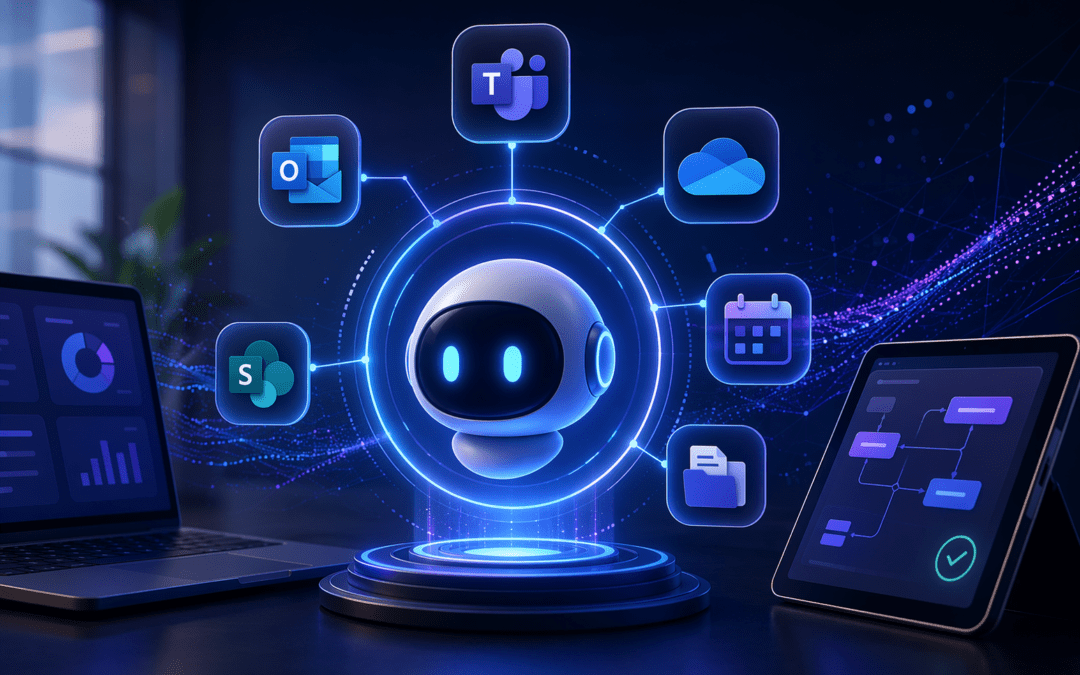
Scout is an agent fully integrated into:
- Microsoft Teams
- Outlook
- OneDrive
- SharePoint
Work directly on:
- Emails
- Meetings
- Chats
- Documents
- Contacts
👉 That is to say, about the real business context.
Connected apps: Teams, Outlook, OneDrive and SharePoint
Native integration allows:
- Read and generate emails
- Prepare meetings
- Analyse documents
- Coordinate tasks
All without leaving the Microsoft 365 environment.
Always-on capabilities: continuous work without prompts
Scout's big difference:
- It is always active
- It doesn't need to be constantly invoked
- Maintain the context of the work
👉 It works like a persistent assistant, not as a chatbot.
How Autopilot Agents work at a technical level
Behind this capability lies an advanced architecture based on context, reasoning, and action.
Access to context via Microsoft Graph
The agent accesses:
- Emails
- Documents
- Calendar
- Conversations
👉 This allows you to understand the operational reality of the company.
Multi-step task orchestration
The agents:
- They break problems down into steps
- They decide the execution order
- Coordinating actions between tools
👉 They don't solve a task, they solve a complete process.
Integration with external systems using MCP
Thanks to Model Context Protocol (MCP):
- They connect to APIs
- They interact with external tools
- They execute processes outside Microsoft 365
👉 This makes them system orchestrators, not just internal assistants.
Agentic AI architecture at Microsoft: context, reasoning and action
OpenClaw as a basis for agents
Microsoft Scout is built on OpenClaw, an open-source framework for autonomous agents.
Work IQ: enterprise contextual intelligence
Work IQ enables:
- Understanding priorities
- Detect work patterns
- Anticipate necessary actions
👉 It's what makes the agent genuinely “intelligent”.
Hybrid execution: cloud, desktop and browser
Scout can operate:
- In the cloud
- On the desktop
- En el navegador
👉 Esto le da acceso a múltiples entornos de trabajo simultáneamente.
Seguridad, identidad y gobierno en agentes autónomos
Uno de los aspectos clave en empresa.
Identidad propia del agente (Entra ID)
Cada agente:
- Tiene identidad propia
- Actúa en nombre del usuario
- Respeta permisos y políticas
Control de permisos y políticas
La organización define:
- Qué puede hacer el agente
- A qué datos accede
- Qué acciones puede ejecutar
Supervisión y validación (human-in-the-loop)
- Las acciones críticas requieren validación
- Existe trazabilidad completa
- Se mantiene el control humano
👉 Autonomía sí, pero gobernada.
Caso práctico: automatización de la preventa con IA agéntica
Problema actual en procesos de preventa
En una consultora como Next Step:
- Revisar emails de contactos
- Seleccionar los leads
- Buscar documentación
- Preparar propuestas
- Coordinar reuniones
👉 Supone mucho esfuerzo comercial
Flujo automatizado con Autopilot Agent
Hemos automatizado parte de nuestra acción comercial con un agente:
- Detecta un correo con oportunidad
- Analiza el contexto del cliente
- Busca propuestas y casos similares
- Genera un borrador de propuesta
- Sugiere respuesta y próxima acción
👉 Todo con intervención mínima.
Impacto en productividad y eficiencia comercial
- Reducción del tiempo de preventa
- Mayor velocidad de respuesta
- Mejor aprovechamiento del conocimiento interno
- Estandarización del discurso
👉 El equipo comercial hemos reducido tiempo de seleccionar y contestar emails y preparar propuestas, que ahora podemos dedicar a atender al cliente y tomar decisiones de valor.
Qué implica esto para las empresas: oportunidad y preparación
Preparación del dato y gobernanza
Sin datos organizados:
- El agente no entiende contexto
- La calidad de resultados cae
Definición de casos de uso
Es clave empezar por:
- Procesos repetitivos
- Tareas intensivas en conocimiento
- Escenarios con ROI claro
Evolución progresiva hacia automatización real
Fases recomendadas:
- Asistencia (copilot)
- Sugerencia (semi-autónomo)
- Ejecución controlada (autopilot)
Conclusión: hacia una nueva fuerza de trabajo digital
Los Autopilot Agents marcan un cambio estructural en la forma de trabajar.
Ya no hablamos de herramientas que ayudan, sino de sistemas que:
- Entienden el contexto
- Toman decisiones
- Ejecutan tareas
Esto abre la puerta a una nueva realidad: la fuerza de trabajo digital basada en agentes de IA.
Las organizaciones que sepan adoptar este modelo con criterio no solo ganarán eficiencia, sino que transformarán su forma de operar.
🚀 Next Step te ayudamos a dar el paso a la IA Agéntica
We Next Step ayudamos a las organizaciones a dar este paso hacia la IA agéntica:
- Identificando casos de uso reales
- Preparando el entorno Microsoft 365
- Diseñando arquitecturas seguras
- Implantando agentes con impacto en negocio
👉 ¿Quieres explorar cómo aplicar Autopilot Agents en tu empresa? Hablemos.
Contact | Next Step Consultants